Thread Density Variations in Basketball Shorts That Influence Mobility During Rapid Directional Shifts on Indoor Courts
Written by Mia Lehmann · Nov 25, 2026
Thread Density Variations in Basketball Shorts That Influence Mobility During Rapid Directional Shifts on Indoor Courts
Thread density in basketball shorts refers to the number of yarns woven per square inch, and variations in this measurement directly affect how the fabric stretches and recovers during quick cuts on polished indoor surfaces. Manufacturers adjust these counts to balance durability with the freedom of movement that players need when pivoting at high speeds. Data from textile testing labs shows that lower thread densities often allow greater lateral stretch, while higher densities provide more structured support without restricting range.
Defining Thread Density in Performance Apparel
Thread density combines warp and weft counts, and sports apparel producers measure these values using standardized ASTM methods that track both tensile strength and elongation under load. Researchers at institutions across North America and Europe have documented how a density shift of 20 threads per inch can change fabric modulus by up to 15 percent. This matters on indoor courts because friction between the sole and the floor transmits force through the garment during deceleration phases of a crossover or spin move. Observers note that shorts with densities around 120 threads per inch tend to conform more closely to the thigh, reducing excess fabric that could catch during recovery steps.
How Density Affects Fabric Behavior in Directional Changes
When an athlete plants a foot and rotates the torso, the shorts must accommodate both circumferential stretch and shear forces along the seams. Lower-density weaves permit yarns to slide past one another, creating temporary elongation that snaps back once the movement completes. Higher-density constructions resist this slide, instead relying on inherent fiber elasticity such as that found in elastane blends. Studies conducted by the Australian Sports Commission in collaboration with university textile departments indicate that players executing repeated 90-degree cuts experience measurable differences in stride recovery time based on these fabric characteristics. The interaction becomes more pronounced on synthetic court surfaces where grip coefficients exceed 0.8, forcing the garment to handle peak loads within fractions of a second.
Material Compositions and Weave Structures
Most performance basketball shorts combine polyester filaments with small percentages of spandex, yet the base thread density determines how those elastomeric fibers distribute stress. Plain weaves at moderate densities allow air permeability that prevents heat buildup, whereas twill or satin patterns at higher counts increase surface smoothness and reduce drag against opposing players. One study published by the European Textile and Apparel Confederation examined shorts used in professional leagues and found that densities between 90 and 110 threads per inch optimized the trade-off between ventilation and shape retention after 40 minutes of continuous play. Those findings align with observations from Canadian university labs that tracked fabric samples under cyclic loading simulating game conditions.
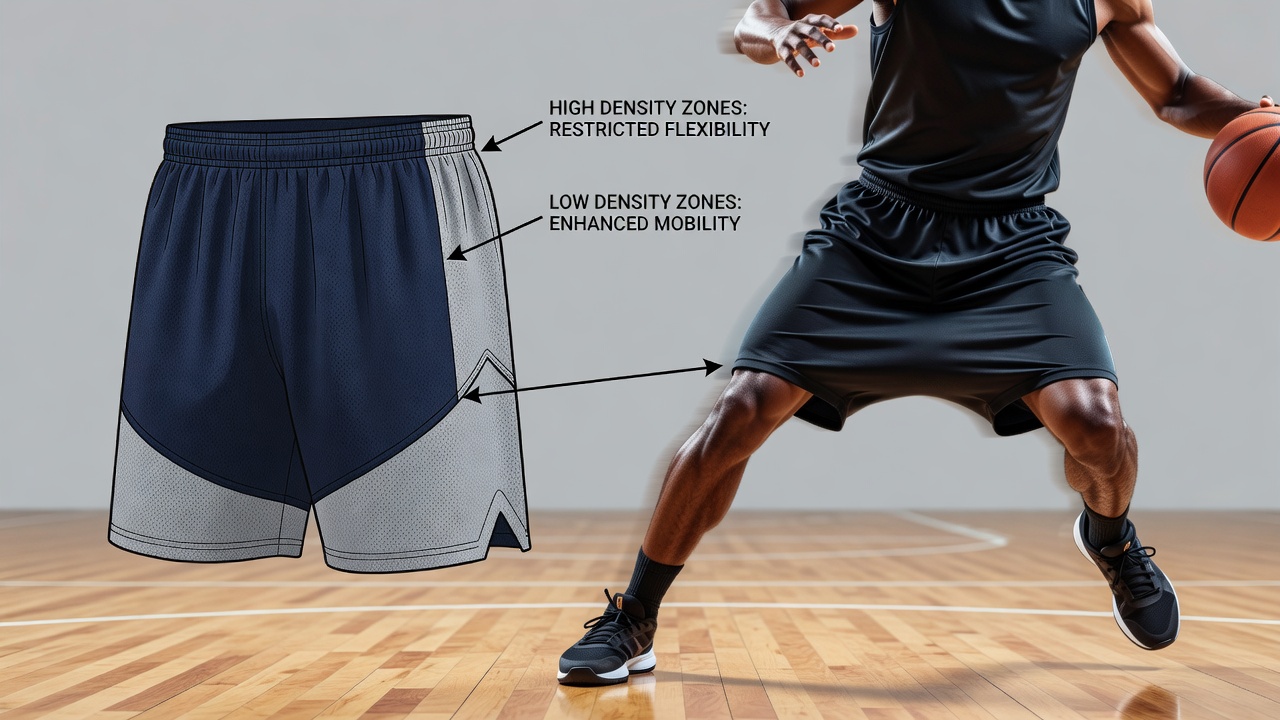
Additional factors include yarn thickness and finish treatments applied after weaving. Finer yarns packed at higher densities create tighter surfaces that resist pilling from repeated floor contact, yet they can limit the fabric's ability to shear without resistance. Manufacturers therefore calibrate these parameters against biomechanical data collected during motion-capture sessions. The result appears in products released ahead of the 2026 season, where several suppliers introduced models with zoned density mapping that places lower counts along the inseam and higher counts across the waistband.
Testing Protocols and Performance Metrics
Industry groups such as the International Association of Sports Surface Sciences have developed protocols that replicate indoor court conditions in controlled environments. These tests measure lateral force transmission through the garment while a mechanical leg assembly performs programmed directional shifts. Results reveal that density variations influence both peak torque at the hip joint and the time required for the fabric to return to its resting state. Data collected in 2025 and early 2026 continues to inform design iterations, particularly for teams that practice multiple times per week on the same hardwood floors.
Teams in different regions apply these insights according to local climate and playing style. In warmer indoor facilities, lower-density sections improve moisture wicking rates, whereas colder venues benefit from denser constructions that retain body heat during warm-ups. The interplay between these variables explains why several professional organizations now specify density tolerances in their uniform contracts rather than relying solely on weight or stretch percentage claims.
Conclusion
Thread density remains a foundational variable that apparel engineers adjust to match the demands of rapid directional shifts on indoor courts. Measurements taken across multiple studies demonstrate consistent relationships between yarn count, fabric modulus, and movement efficiency. As testing methods evolve and new fiber blends enter production, manufacturers continue to refine these parameters to meet the specific mechanical requirements of basketball played at competitive levels.